
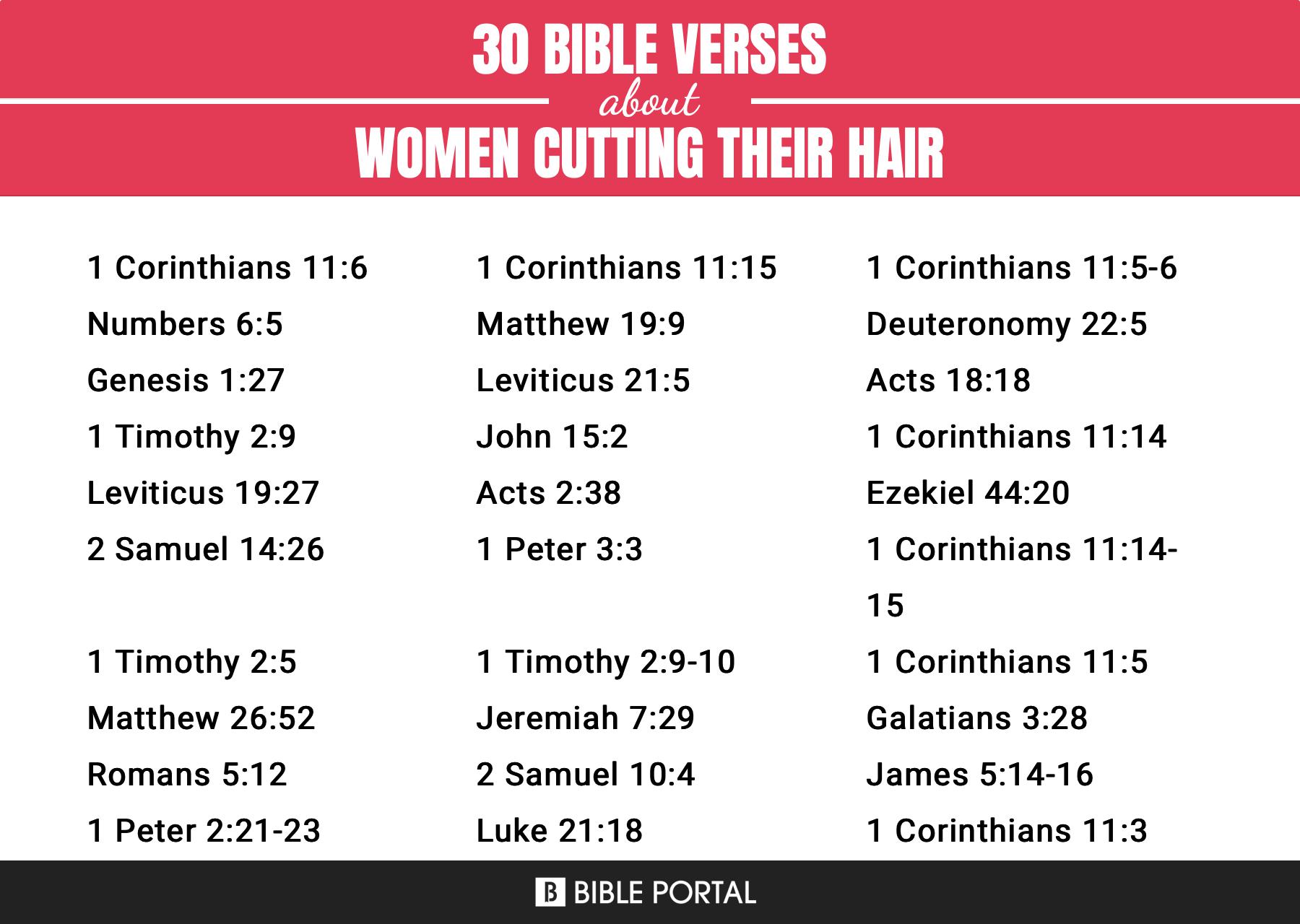
Have you ever wondered what the Bible says about a woman cutting her hair? It’s a topic that has sparked debate and curiosity among believers for centuries. In this blog post, we will explore the different perspectives and teachings found within the Scriptures regarding this matter. Understanding what the Bible says about a woman cutting her hair can provide valuable insights into our faith and help us make informed decisions in our daily lives. So, let’s dive in and discover the wisdom and guidance that the Word of God offers on this intriguing subject.
The Biblical Perspective on Women Cutting Their Hair
The Bible has various references to the topic of women cutting their hair. These passages provide insights into the cultural and religious significance associated with this practice during biblical times. While there are no explicit commands or prohibitions regarding women cutting their hair in the Bible, there are indications of specific customs and beliefs surrounding this issue.
One significant passage discussing women’s hair is found in 1 Corinthians 11:6, which states, “For if a woman does not cover her head, she might as well have her hair cut off; but if it is a disgrace for a woman to have her hair cut off or her head shaved, then she should cover her head.” This verse suggests that there was a cultural expectation for women to have long hair and to cover their heads as a sign of modesty and submission.
In biblical times, long hair was often associated with femininity and beauty. It was seen as a symbol of a woman’s glory (1 Corinthians 11:15). The act of cutting one’s hair could be interpreted as going against these traditional gender roles or societal norms. However, it is important to note that the emphasis here is on the covering of the head rather than the actual cutting of hair.
Additionally, the story of Samson in the book of Judges provides another perspective on hair and its significance. Samson was known for his extraordinary strength, which was derived from his long hair. Delilah, a woman who sought to betray him, eventually discovered the secret to his strength and had his hair cut off, leading to his downfall. This narrative highlights the symbolic power associated with hair and how it can represent divine favor or enable supernatural abilities.
While these passages offer insights into the cultural context of women’s hair in biblical times, it is essential to interpret them within their historical and cultural framework. Customs and beliefs surrounding hairstyles have evolved over time, and what may have been significant in ancient times may not carry the same weight in contemporary society.
In conclusion, the Bible does not explicitly prohibit women from cutting their hair. However, it does provide insights into the cultural and religious significance attached to this practice during biblical times. The emphasis is often placed on modesty, submission, and adherence to societal norms rather than the actual act of cutting hair. Ultimately, individuals should consider the principles of love, respect, and honoring God in their personal choices regarding hairstyles.
What does it mean when a woman cuts off her hair?
In the context of the Bible, cutting off a woman’s hair can have different symbolic meanings depending on the specific passage or story being referred to. However, it is important to note that hair symbolism in the Bible is often related to cultural and historical contexts, and interpretations may vary.
One notable instance in the Bible where a woman cutting off her hair is mentioned is in 1 Corinthians 11:6. The passage discusses the importance of head coverings for women during prayer or prophesying. In this context, cutting off one’s hair was seen as a sign of immodesty or disrespect towards cultural norms of that time.
Another biblical story that involves a woman cutting off her hair is found in the book of Judges, specifically in the story of Samson and Delilah (Judges 16:17). Delilah was tasked with discovering the source of Samson’s strength and eventually cut off his hair, which was believed to be the secret to his power. This act of cutting off Samson’s hair symbolized the loss of his strength and ultimately led to his capture.
In both cases, the act of cutting off hair represents a significant change or consequence. It could signify disobedience to cultural norms, loss of power or strength, or even a form of punishment. However, the specific interpretation may vary depending on the context and story being examined.
Is it good for a woman to shave her hair according to the Bible?
According to the Bible, there are different passages that mention hair and its significance. In 1 Corinthians 11:15, it says, “But if a woman has long hair, it is her glory; for her hair is given to her for a covering.” This verse emphasizes the importance of women having long hair as a symbol of their femininity and glory.
However, it’s important to note that this verse does not explicitly address the topic of shaving hair. The Bible does not specifically forbid or command women to shave their hair. Therefore, whether a woman chooses to shave her hair or keep it long is a personal decision that should be guided by individual conviction and cultural norms.
It’s also worth mentioning that in some biblical accounts, shaving hair was associated with mourning or penitence, as seen in passages like Job 1:20 and Jeremiah 7:29. These instances indicate that the act of shaving hair can carry symbolic meanings in specific contexts.
Ultimately, while the Bible emphasizes the beauty and significance of women’s long hair, it does not provide a direct answer regarding whether it is good or bad for a woman to shave her hair. It is up to each person to prayerfully consider their own convictions and cultural context when making decisions about hair length and style.
What does God say about cutting your hair?
In the Bible, there are several passages that mention cutting hair. However, it’s important to note that the context and interpretation of these passages can vary among different scholars and religious denominations.
One notable verse is found in 1 Corinthians 11:14-15, where it says, “Does not even nature itself teach you that if a man has long hair, it is a dishonor to him? But if a woman has long hair, it is a glory to her; for her hair is given to her for a covering.” This passage suggests that it is more culturally acceptable for men to have shorter hair and for women to have longer hair.
Another passage, found in Leviticus 19:27, states, “You shall not round off the hair on your temples or mar the edges of your beard.” This verse is often interpreted as a commandment for men to refrain from shaving their beards or cutting their hair in specific ways.
However, it’s important to recognize that these passages are part of a larger cultural and historical context. The Bible does not explicitly mandate a specific hairstyle or length of hair for believers. Ultimately, the decision on how to style one’s hair should be based on personal conviction and cultural norms, keeping in mind principles of modesty and respect for oneself and others.
What does the Bible say about a woman cutting her hair KJV?
In the context of the Bible, specifically in the King James Version (KJV), the topic of a woman cutting her hair is mentioned in 1 Corinthians 11:15. The verse states:
“But if a woman have long hair, it is a glory to her: for her hair is given her for a covering.”
1 Corinthians 11:15 (KJV)
This verse suggests that a woman’s long hair is considered a glory for her and serves as a natural covering. However, it does not explicitly say that women should not cut their hair. The Bible does not provide specific guidelines or commands regarding the length or style of a woman’s hair. It ultimately leaves personal choices about hairstyles to individual conviction and cultural considerations.
FAQs
Is it a sin for a woman to cut her hair according to the Bible?
No, it is not a sin for a woman to cut her hair according to the Bible.
Does the Bible provide any guidelines or restrictions regarding women cutting their hair?
Yes, the Bible does provide guidelines regarding women cutting their hair. In 1 Corinthians 11:15, it states that long hair is given to women as a covering. However, it does not explicitly forbid women from cutting their hair.
What are the biblical implications of a woman choosing to have a short haircut?
There is no specific biblical implication regarding a woman choosing to have a short haircut. Different interpretations may exist, but the Bible does not provide explicit instructions or restrictions on hairstyles for women.